Many industrial buildings have impressive dimensions, especially when it comes to height.
This means that if maintenance or servicing work needs to be carried out inside or outside these industrial buildings, workers could be exposed to the risk of falling from heights high enough to cause significant injury.
To prevent such incidents when working at height, industrial guardrails have repeatedly proven their effectiveness.
In this text, Omnifab’s specialists in securing infrastructures at height share with you several facts you need to know about industrial guardrails.
What is an industrial guardrail?
According to the definition provided by the CNESST, a guardrail is a form of collective protection designed to prevent falls.
Designing a compliant guardrail
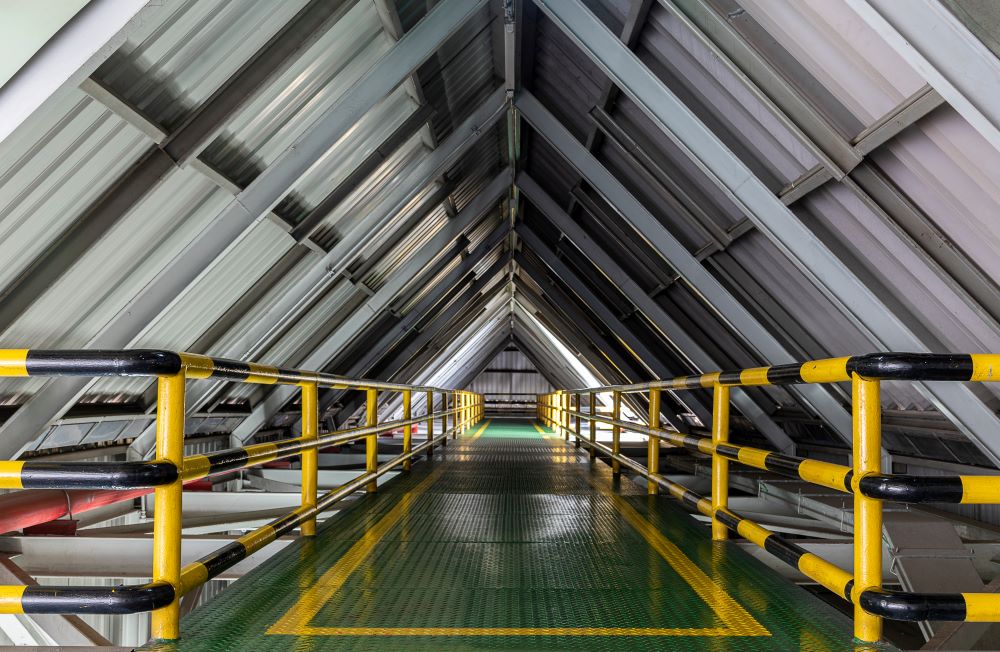
Generally speaking, to be considered compliant, a guardrail must consist of :
- a top rail laid flat, located between 1 m and 1.2 m above the area where the worker is standing;
- an intermediate rail at mid-height;
- a toeboard installed at floor level to retain objects and tools.
Table: Components of a Compliant Industrial Guardrail
| Component | Description | Function |
| Top rail | Installed between 1 m and 1.2 m above the working surface | Prevents workers from falling from the edge |
| Midrail | Positioned midway between the top rail and the floor | Reduces the risk of workers passing under the guardrail |
| Toeboard | Installed at floor level along the edge | Prevents tools or objects from falling |
Where should industrial railings be installed?
These are installed at the edge of the void, on the sides of a floor, roof, platform, elevating platform, scaffolding, walkway, staircase or ramp.
Also according to the CNESST, a guardrail should be securely fastened at all points where a worker is at risk of falling, such as :
- into a liquid or hazardous substance;
- from a height of 1.2 m or more when using a wheelbarrow or vehicle;
- from a height of over 3 m in all other cases.
Also, the guardrail must be able to withstand a horizontal force of 900 N and a vertical force of 450 N applied at any point on the top rail.
However, a guardrail may be temporarily removed during work if it interferes with the execution of the work. In this case, workers are required to wear a safety harness connected to an anchoring system by a fall arrest connection.